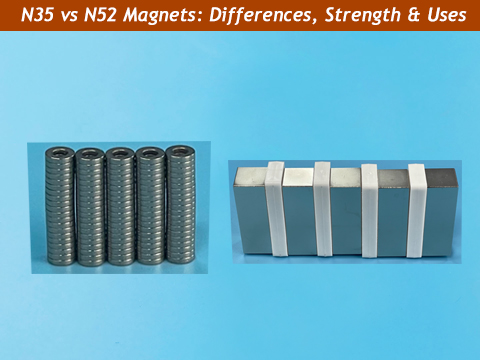
Introduction: N35 vs N52 Magnets — What Is the Difference?
Neodymium magnets are widely used in industrial products because they provide strong magnetic force in a small size. Among different neodymium magnet grades,
N35 and N52 magnets are two common choices.
The main difference between N35 and N52 magnets is
magnetic strength. N52 magnets are stronger than N35 magnets of the same size, which means they can provide higher magnetic force in a smaller space.
However, a stronger magnet is not always the best choice for every application.
N35 magnets offer a good balance between performance, cost, and reliability, making them suitable for many general industrial applications.
When choosing between N35 and N52 magnets, engineers should consider more than magnetic strength. Factors such as working temperature, available space, application requirements, and budget are also important.
N52 magnets are often used when maximum magnetic force is needed in a compact design, such as small motors, sensors, and electronic devices. N35 magnets are a cost-effective option for applications where extremely high magnetic strength is not required.
In this article, we will compare
N35 vs N52 magnets in terms of strength, temperature performance, applications, and cost to help you choose the right magnet grade for your project.
Understanding N35 and N52 Neodymium Magnet Grades
Before comparing N35 and N52 magnets, it is important to understand what the magnet grade means.
Neodymium magnet grades are usually written as a letter
“N” followed by a number, such as
N35, N42, or N52. The letter
“N” refers to standard neodymium magnets, while the number indicates the magnet’s
maximum energy product (BHmax), measured in
Mega Gauss Oersteds (MGOe).
The higher the number, the more magnetic energy the magnet can produce.
For example:
|
Magnet Grade |
Maximum Energy Product |
|
N35 |
About 35 MGOe |
|
N52 |
About 52 MGOe |
This means an
N52 magnet can generate more magnetic force than an N35 magnet when both magnets have the same size and shape.
However, the grade number does not represent every aspect of magnet performance. A higher grade does not always mean a better choice for all applications. Other factors, such as:
· Magnet size and shape
· Working temperature
· Required holding force
· Cost requirements
· Operating environment
Also affects the final magnet selection.
N35 vs N52 Magnets: Key Differences in Magnetic Performance
The biggest difference between
N35 and N52 magnets is their magnetic strength. Since N52 has a higher energy product than N35, it can produce a stronger magnetic field when the magnet size and shape are the same.
However, the actual performance difference depends on the design and working conditions of the application. A higher-grade magnet does not always mean a better solution. Engineers need to select the right grade based on the required magnetic force, available space, and operating environment.
Magnetic Strength Comparison
The main magnetic properties of N35 and N52 magnets are shown below:
|
Property |
N35 Magnets |
N52 Magnets |
|
Maximum Energy Product |
About 35 MGOe |
About 52 MGOe |
|
Magnetic Strength |
Standard |
Higher |
|
Remanence (Br) |
Around 11.7–12.2 kGs |
Up to 14.8 kGs or higher |
|
Magnetic Force |
Good |
Very strong |
|
Size Efficiency |
Requires a larger size for the same force |
Can achieve higher force in a smaller size |
An N52 magnet can provide approximately
40–50% higher magnetic energy compared with an N35 magnet. This allows designers to reduce magnet size while maintaining the required magnetic performance.
For example, if a device has limited installation space, an N52 magnet may provide the same magnetic force as a larger N35 magnet. This advantage is especially useful in compact applications such as:
· Small electric motors
· Sensors
· Robotics
· Electronic devices
· Magnetic assemblies with limited space
Does a Higher Grade Always Mean Better Performance?
Not necessarily.
Although N52 magnets provide stronger magnetic force, they are not always the best choice for every application. In many industrial products, the required magnetic force can already be achieved with N35 magnets.
Using a higher-grade magnet when it is not needed may increase material costs without providing additional benefits.
For example:
· A large industrial magnetic fixture may work well with N35 magnets.
· A compact precision device with strict size limitations may require N52 magnets.
The best magnet choice depends on the overall product design, not only the magnet grade.
Key Takeaway
In simple terms:
·
N35 magnets provide reliable magnetic performance with better cost efficiency.
·
N52 magnets provide maximum magnetic strength when space and weight are limited.
However, magnetic strength is only one part of magnet selection. Temperature performance is another important factor, especially for applications exposed to heat. In the next section, we will compare the
temperature stability of N35 and N52 magnets.
N35 vs N52 Magnets: Temperature Performance and Thermal Stability
Magnetic strength is not the only factor to consider when selecting a neodymium magnet grade.
Temperature stability is also important, especially for applications exposed to heat.
The difference between N35 and N52 magnets is not only the increase in magnetic force. It is also related to the balance between
remanence (Br) and
intrinsic coercivity (Hcj).
A higher grade magnet, such as N52, is designed to achieve higher magnetic output. However, standard high-energy grades usually have greater sensitivity to temperature because their internal magnetic structure is optimized for higher remanence rather than maximum heat resistance.
In simple terms:
·
Higher grade = stronger magnetic force
·
Higher coercivity = better resistance to heat and demagnetization
Therefore, choosing the highest magnetic grade does not always guarantee the best performance in high-temperature environments.
N35 Magnet Temperature Performance
Standard
N35 neodymium magnets provide a good balance between magnetic strength and thermal stability.
Typical characteristics:
· Maximum working temperature: around
80°C
· Balanced magnetic performance and cost
· Suitable for general industrial applications under normal temperature conditions
Because N35 does not focus on achieving the highest possible magnetic energy, it can provide reliable performance for many applications where extreme magnetic strength is not required.
Common applications include:
· Industrial magnetic assemblies
· Magnetic holders
· Sensors
· General automation equipment
N52 Magnet Temperature Performance
N52 magnets are among the strongest standard neodymium magnet grades available. They can provide very high magnetic performance, with remanence values reaching
14.8 kGs or higher in some cases.
However, standard N52 magnets require more careful temperature management.
Compared with lower grades, standard N52 magnets generally have lower thermal stability because the material composition is optimized for maximum magnetic energy. When exposed to elevated temperatures, they may experience
irreversible magnetic loss.
For example:
· In some applications, standard N52 magnets may begin to experience noticeable magnetic degradation above around
60°C, depending on the magnet design and operating conditions.
· Long-term exposure to heat can reduce magnetic performance if the magnet is not selected correctly.
This is especially important for applications such as:
· Wireless charging magnetic accessories
· Compact electronic devices
· Small motors
· High-density magnetic assemblies
Choosing High-Temperature Grades for Heat Applications
When an application requires both strong magnetic performance and higher temperature resistance, engineers usually select high-temperature neodymium grades instead of standard N grades.
Common options include:
· N35H
· N42SH
· N52SH
· N42UH
These grades increase intrinsic coercivity (Hcj), improving resistance to thermal demagnetization.
For example:
·
N52 → maximum magnetic strength
·
N52SH → similar high magnetic performance with improved temperature resistance
Key Takeaway
When comparing N35 and N52 magnets, magnetic strength is only one part of the decision.
·
N35 magnets provide a balanced solution with good performance, cost efficiency, and reliable temperature stability.
·
N52 magnets provide higher magnetic force for compact designs but require more attention to operating temperature.
·
High-temperature grades should be considered when magnets need to operate in hot environments.
The best magnet grade is not always the strongest one. It is the grade that provides the right balance between
magnetic force, temperature stability, and application requirements.
How to Select Between N35 and N52 Magnets for Your Application
Selecting between N35 and N52 magnets is not simply about choosing the stronger grade. The correct choice depends on the actual requirements of the product design.
Before selecting a magnet grade, engineers should evaluate several key factors:
1. Available Space and Magnet Size Requirements
If the installation space is limited, a higher-grade magnet such as N52 can provide stronger magnetic force in a smaller size.
For example, compact products such as:
· Miniature motors
· Sensors
· Magnetic charging accessories
often require high-performance magnets because there is limited room for a larger magnet.
However, if the available space is not restricted, an N35 magnet may achieve the required performance at a lower cost.
2. Required Magnetic Force
The required magnetic force is one of the most important factors in magnet selection.
If the application only needs standard magnetic performance, N35 magnets are often sufficient. Using a higher-grade magnet may increase cost without providing meaningful benefits.
For applications that require maximum holding force or stronger magnetic fields, N52 magnets can provide advantages.
The goal is not to choose the strongest magnet available, but to choose the grade that meets the performance requirements.
3. Operating Temperature
Temperature conditions should always be considered during magnet selection.
Standard N35 and N52 magnets have different thermal characteristics. For applications exposed to heat, engineers should evaluate:
· Continuous operating temperature
· Short-term temperature peaks
· Risk of irreversible demagnetization
If the application requires both high magnetic strength and high temperature resistance, high-coercivity grades such as
N35H, N42SH, or N52SH may be more suitable.
4. Cost and Production Volume
For large-scale industrial production, material cost is an important consideration.
Although N52 magnets provide higher magnetic performance, they are generally more expensive than N35 magnets. If N35 can meet the required magnetic performance, it is often the more economical solution.
A properly optimized magnet design can reduce costs without sacrificing product performance.
Practical Selection Rule
A simple guideline:
· Choose
N35 when you need a reliable and cost-effective solution for general applications.
· Choose
N52 when you need maximum magnetic force in a limited space.
· Choose
high-temperature grades when the application requires both strong magnetic performance and heat resistance.
The best magnet grade is determined by the complete application requirements, not only by the highest magnetic grade available.
Conclusion: The Best Magnet Is the One That Fits the Application
When comparing
N35 vs N52 magnets, it is easy to focus only on magnetic strength. However, a successful magnet design requires more than choosing the highest grade.
A stronger magnet can improve performance, but it may also increase cost and require more attention to temperature conditions. In many applications, a well-selected N35 magnet can deliver reliable performance without unnecessary material costs.
For compact designs where space is limited, an N52 magnet can provide valuable advantages by delivering higher magnetic force in a smaller size. For other applications, stability, efficiency, and cost may be more important than maximum strength.
The right choice comes from understanding the complete application, not simply selecting the strongest magnet available.
By balancing
magnetic performance, operating conditions, and cost, engineers can create a more reliable and efficient magnetic solution.