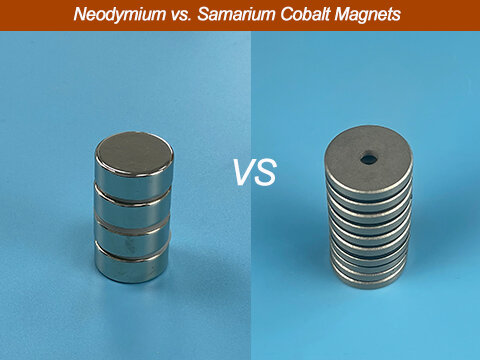
Samarium Cobalt (SmCo) magnets and Neodymium (NdFeB) magnets are two types of rare earth permanent magnets. Both offer strong magnetic performance, but they have different advantages and are used in different applications.
Neodymium magnets are the strongest type of permanent magnets currently available. They provide very high magnetic force in a small size, making them widely used in electric motors, speakers, sensors, and many other industrial products.
Samarium Cobalt magnets are known for their excellent temperature stability and resistance to corrosion. They can maintain reliable performance in high-temperature and harsh environments, making them ideal for aerospace, military, and high-performance industrial applications.
The main difference comes from their materials:
Simply put:
|
Magnet Type |
Main Advantages |
|
Neodymium Magnets (NdFeB) |
Stronger magnetic force, lower cost, widely available |
|
Samarium Cobalt Magnets (SmCo) |
Higher temperature resistance, better corrosion resistance, more stable performance |
Choosing between SmCo and NdFeB magnets depends on your application requirements. Factors such as operating temperature, magnetic strength, working environment, and budget all need to be considered.
In the following sections, we will compare Samarium Cobalt magnets vs Neodymium magnets to help you understand their differences and choose the right magnet for your project.
Before looking at the details, it is helpful to see the main differences between Samarium Cobalt (SmCo) magnets and Neodymium (NdFeB) magnets at a glance.
Both magnets provide excellent magnetic performance, but they are designed for different working conditions. Neodymium magnets focus on maximum magnetic strength and cost efficiency, while Samarium Cobalt magnets focus on stability, temperature resistance, and durability.
|
Property |
Samarium Cobalt Magnets (SmCo) |
Neodymium Magnets (NdFeB) |
|
Magnetic Strength |
High |
Very high (the strongest permanent magnet) |
|
Maximum Energy Product |
Up to around 33 MGOe |
Up to around 56 MGOe |
|
Temperature Resistance |
Excellent |
Good (depends on grade) |
|
Maximum Operating Temperature |
Up to 350°C–550°C depending on grade |
Usually 80°C–230°C depending on grade |
|
Corrosion Resistance |
Excellent |
Requires coating for better protection |
|
Mechanical Strength |
More brittle |
More brittle and prone to chipping |
|
Cost |
Higher |
Lower |
|
Common Applications |
Aerospace, defense, high-temperature motors, sensors |
Motors, speakers, automation equipment, consumer electronics |
In terms of magnetic strength, Neodymium magnets have the advantage. They can generate a stronger magnetic field in a smaller size, which makes them ideal for applications where space and weight are limited.
However, SmCo magnets perform better in extreme environments. They can maintain stable magnetic properties at high temperatures and have excellent resistance to oxidation and corrosion without requiring additional coatings.
The best choice depends on what matters most for your application:
Magnetic strength is one of the most important factors when selecting between Neodymium (NdFeB) magnets and Samarium Cobalt (SmCo) magnets.
Neodymium magnets are the strongest permanent magnets currently available. They offer the highest magnetic energy density, with maximum energy products exceeding 50 MGOe and remanence values reaching around 1.4 Tesla. This allows Neodymium magnets to generate a very strong magnetic field while maintaining a compact size.
Because of their high magnetic performance, Neodymium magnets are widely used in applications where high power and small size are important, such as:
Samarium Cobalt magnets also provide strong magnetic performance, with typical maximum energy products in the range of 25–35 MGOe. While their magnetic strength is lower than Neodymium magnets, SmCo magnets offer better stability in demanding environments, especially where high temperature resistance and long-term reliability are required.
The key difference can be summarized as:
|
Property |
Neodymium Magnets (NdFeB) |
Samarium Cobalt Magnets (SmCo) |
|
Magnetic Strength |
Higher |
High |
|
Maximum Energy Product |
50+ MGOe |
25–35 MGOe |
|
Main Advantage |
Maximum magnetic force in a small size |
Stable performance in harsh environments |
|
Best For |
Compact, high-power applications |
High-temperature and reliable applications |
In simple terms:
The strongest magnet is not always the best choice. The right magnet depends on the complete application requirements, including size limitations, operating temperature, and working environment.
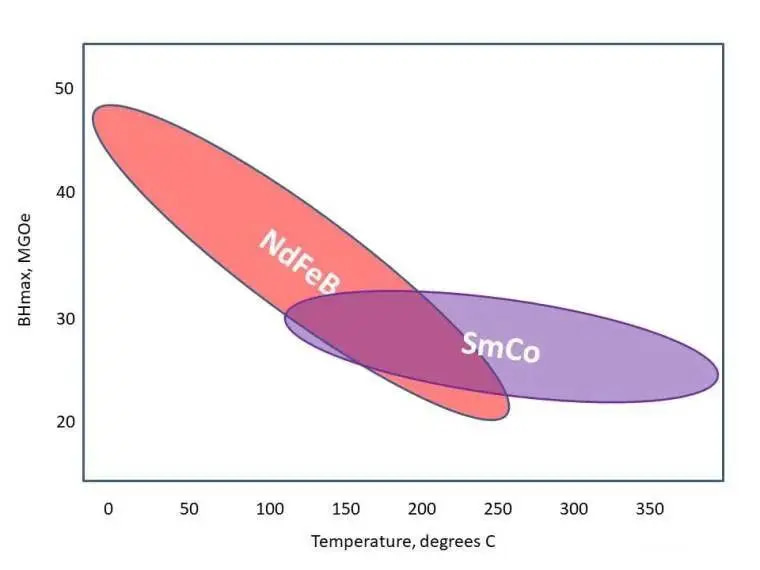
Temperature resistance is one of the biggest differences between Samarium Cobalt (SmCo) magnets and Neodymium (NdFeB) magnets.
A magnet does not always perform the same at different temperatures. As the temperature increases, its magnetic strength can gradually decrease. Therefore, choosing the right magnet is important for applications that work in high-temperature environments.
Neodymium magnets provide excellent magnetic strength, but their performance is more affected by heat. Depending on the grade, high-temperature Neodymium magnets can typically work at temperatures up to around 220°C.
Samarium Cobalt magnets are designed for high-temperature applications. They can maintain stable magnetic performance at temperatures up to around 350°C, making them a better choice for extreme working conditions.
The difference becomes more noticeable in high-temperature environments:
|
Property |
Neodymium Magnets (NdFeB) |
Samarium Cobalt Magnets (SmCo) |
|
Maximum Working Temperature |
Up to around 220°C |
Up to around 350°C |
|
Curie Temperature |
About 320°C–460°C |
About 700°C–800°C |
|
Temperature Stability |
Good |
Excellent |
The Curie temperature is the point where a magnet completely loses its permanent magnetic properties. SmCo magnets have a much higher Curie temperature, which means they can tolerate higher heat before losing their magnetism.
Another advantage of SmCo magnets is that their magnetic performance changes less when the temperature changes. For example, Sm₂Co₁₇ magnets have a temperature coefficient of around -0.03%/°C, while NdFeB magnets are around -0.12%/°C. This means SmCo magnets can maintain more stable performance in environments with temperature fluctuations.
Because of these advantages, SmCo magnets are commonly used in applications where reliability at high temperatures is critical, such as:
In simple terms:
Corrosion resistance is another important difference between Samarium Cobalt (SmCo) magnets and Neodymium (NdFeB) magnets, especially for applications exposed to moisture, salt spray, or chemical environments.
Samarium Cobalt magnets have excellent natural corrosion resistance. Their composition contains a high percentage of cobalt, which provides strong resistance against oxidation. Because of this, SmCo magnets usually do not require additional surface coatings and can maintain stable performance in humid or corrosive environments.
In contrast, Neodymium magnets contain iron and neodymium, which are more likely to oxidize when exposed to moisture and oxygen. Without proper protection, NdFeB magnets may corrode and lose performance over time. Therefore, most Neodymium magnets require protective coatings, such as:
The difference can be summarized as:
|
Property |
Neodymium Magnets (NdFeB) |
Samarium Cobalt Magnets (SmCo) |
|
Corrosion Resistance |
Moderate |
Excellent |
|
Surface Coating |
Usually required |
Usually not required |
|
Humidity Resistance |
Depends on coating protection |
Naturally resistant |
|
Suitable Environments |
General industrial applications |
Marine, aerospace, and harsh environments |
Because of their excellent corrosion resistance, SmCo magnets are often used in applications where reliability and long service life are critical, such as:
However, Neodymium magnets remain widely used because their high magnetic strength and lower cost make them suitable for many applications. With proper coating protection, NdFeB magnets can also provide reliable performance in many industrial environments.
In simple terms:
Cost is an important consideration when choosing between Neodymium (NdFeB) magnets and Samarium Cobalt (SmCo) magnets.
In general, Neodymium magnets are more affordable than Samarium Cobalt magnets. This is mainly due to differences in raw materials and production scale.
Neodymium magnets are mainly made from neodymium, iron, and boron. Their manufacturing process is mature, and large-scale production helps reduce costs. Although some high-temperature NdFeB grades may require additional elements such as dysprosium or terbium, they are still widely produced for many industrial applications.
Samarium Cobalt magnets contain samarium and cobalt, with cobalt being a more expensive material. The higher raw material cost and more specialized manufacturing process make SmCo magnets significantly more expensive than NdFeB magnets.
For high-volume applications where cost and magnetic strength are the main priorities, Neodymium magnets are usually the preferred choice.
However, Samarium Cobalt magnets are often selected when performance and reliability are more important than price. In high-temperature, corrosive, or difficult-to-access environments, the longer service life of SmCo magnets can justify the higher initial cost.
The choice between Samarium Cobalt (SmCo) magnets and Neodymium (NdFeB) magnets depends on the specific requirements of your application.
There is no single "best" magnet for every situation. NdFeB magnets are usually chosen for their high magnetic strength and cost efficiency, while SmCo magnets are preferred when stable performance in extreme environments is required.
Neodymium magnets are widely used in applications that require strong magnetic force, compact size, and competitive pricing.
Common applications include:
For these applications, the high energy density of NdFeB magnets allows manufacturers to create smaller and more efficient products.
Samarium Cobalt magnets are typically used in applications where temperature resistance, corrosion resistance, and long-term reliability are more important than cost.
Common applications include:
SmCo magnets are especially valuable in environments where replacing a failed magnet would be difficult or expensive.
The demand for high-performance magnets is growing with the development of electric vehicles, robotics, automation, and advanced equipment.
In most applications, Neodymium (NdFeB) magnets will continue to be the most widely used rare earth magnets. Their high magnetic strength and competitive cost make them the preferred choice for many industries.
At the same time, magnet manufacturers are continuing to improve NdFeB technology to achieve better temperature resistance and reliability. This allows NdFeB magnets to be used in more demanding applications, including high-performance motors and robotics.
Samarium Cobalt (SmCo) magnets will continue to play an important role in special applications. Although they are more expensive, their excellent temperature stability and corrosion resistance make them valuable for environments where reliability is critical.
In the future:
Instead of replacing each other, NdFeB and SmCo magnets will continue to work side by side, with each material offering advantages for different applications.
Both Samarium Cobalt (SmCo) magnets and Neodymium (NdFeB) magnets are high-performance rare earth magnets. However, they are designed for different applications.
If you need the strongest magnetic force, compact size, and better cost efficiency, Neodymium magnets are usually the right choice. They are widely used in motors, electronics, automation equipment, and many other industrial applications.
If your application requires high-temperature resistance, excellent corrosion resistance, and stable performance over time, Samarium Cobalt magnets are often the better option. They are especially suitable for harsh environments where reliability is important.
There is no single "best" magnet for every application. The right choice depends on your operating temperature, working environment, design requirements, and performance needs.
In the future, NdFeB magnets will continue to be the main choice for most applications because of their high strength and cost advantages. SmCo magnets will continue to play an important role in special applications where high temperature resistance and long-term reliability are critical.
As an experienced neodymium magnet manufacturer and samarium cobalt magnet supplier, AEMagnets provides customized rare-earth magnet solutions for various industrial applications. From magnet grade selection to size and coating requirements, our team can help you find the right magnet solution for your project.
Posted on July 31, 2026 by MagnetAdmin
Posted on July 24, 2026 by MagnetAdmin
Posted on July 06, 2026 by MagnetAdmin
Posted on April 10, 2026 by MagnetAdmin
Posted on September 30, 2025 by MagnetAdmin
Posted on August 07, 2023 by MagnetAdmin
Posted on July 06, 2023 by MagnetAdmin
Posted on October 10, 2023 by MagnetAdmin
Posted on June 27, 2023 by MagnetAdmin
Posted on September 19, 2023 by MagnetAdmin
Hunan AEMagnets Limited
C3-1727, Building C1-C4, Forte Financial Center, No. 751 Xiaoxiang North Road, Yuelu District, Changsha, Hunan 410000, China
+86-731-89578196