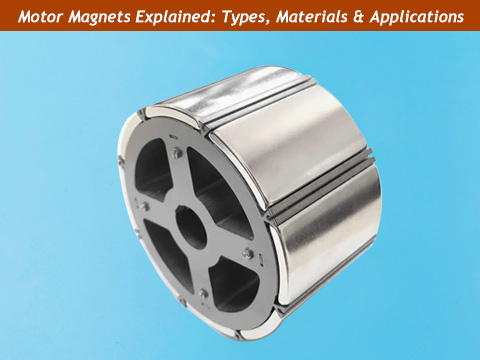
Motor magnets are a key component in electric motors, providing the magnetic fields that make motors operate efficiently and reliably. The choice of magnet material affects performance, energy efficiency, and durability, making it a critical decision in motor design.
They are used in a wide range of applications—from industrial machinery and robotics to electric vehicles and consumer electronics. Understanding the different types of motor magnets and their properties helps ensure the right balance of performance, cost, and reliability.
As a supplier of high-quality permanent magnets, AEMagnets supports engineers and manufacturers in selecting the right materials for their motor projects. This guide explains the main types of motor magnets, their properties, and typical applications, offering practical insights for making informed choices.
Motor magnets are permanent magnets that play a crucial role in the operation of electric motors. In a motor, the rotor and stator work together to convert electrical energy into mechanical motion, and motor magnets generate the magnetic fields that make this process possible.
The main functions of motor magnets include:
Motor magnets are essential for generating the stable magnetic fields that drive motion, enhance efficiency, and support the durability of electric motors. They are a key component in virtually every motor application, from industrial machinery to electric vehicles.
Electric motors use different types of permanent magnets, each offering unique combinations of magnetic strength, temperature resistance, corrosion resistance, and cost. Choosing the right material depends on the motor’s performance requirements, operating environment, and cost considerations.
NdFeB, or neodymium magnets, are currently the most widely used permanent magnets in modern motors. They provide extremely high magnetic strength and energy density, allowing motors to achieve high torque in compact sizes. Their performance makes them ideal for electric vehicles, drones, robotics, and other high-efficiency applications.
However, NdFeB magnets are sensitive to high temperatures and can corrode if exposed to moisture. Protective coatings such as nickel plating or epoxy are often applied to maintain performance and durability.
Key Advantages:
SmCo magnets offer strong magnetic performance with excellent temperature stability. They retain their magnetism under high-temperature conditions and are highly resistant to demagnetization. These properties make SmCo magnets suitable for aerospace, defense, and other specialized industrial motors.
SmCo is more expensive and brittle than NdFeB, so it is typically used in applications where thermal stability and reliability outweigh cost considerations.
Key Advantages:
Ferrite magnets, also called ceramic magnets, are non-metallic and cost-effective. While their magnetic strength is lower than rare-earth magnets, ferrite magnets are resistant to corrosion and maintain stable performance in many standard applications.
They are commonly used in household appliances, automotive accessories, pumps, and fans, where cost efficiency and large-volume production are priorities.
Key Advantages:
AlNiCo magnets are made of aluminum, nickel, and cobalt, and are valued for their high-temperature tolerance and stable magnetic properties. They are less powerful than NdFeB or SmCo but maintain performance in demanding temperature conditions.
These magnets are often used in industrial motors or specialized applications requiring high thermal stability rather than maximum magnetic strength.
Key Advantages:
|
Magnet Type |
Magnetic Strength |
Max Operating Temp |
Corrosion Resistance |
Cost |
Typical Applications |
|---|---|---|---|---|---|
|
NdFeB |
Very High |
150–200 °C |
Moderate |
Medium–High |
EVs, robotics, drones, high-efficiency motors |
|
SmCo |
High |
300 °C |
Excellent |
High |
Aerospace, defense, high-performance industrial motors |
|
Ferrite |
Moderate |
200 °C |
Excellent |
Low |
Appliances, pumps, fans, cost-sensitive motors |
|
AlNiCo |
Moderate |
550 °C |
Good |
Medium |
Specialized industrial motors, high-temp environments |
The magnetic strength, or remanence, determines the torque and efficiency a motor can achieve. Stronger magnets, such as NdFeB, allow for more compact motor designs while delivering higher power. Applications that demand high torque or compact form factors benefit most from high-strength magnets.
Coercivity measures a magnet’s resistance to losing its magnetism. Motors operating in high-temperature environments or exposed to strong external magnetic fields require magnets with high coercivity, such as SmCo, to maintain performance over time.
Every magnet has a maximum operating temperature. Beyond this point, the magnet can lose strength or become permanently demagnetized. For example, NdFeB magnets typically operate up to 150–200 °C, SmCo up to 300 °C, and AlNiCo up to 550 °C. Choosing a magnet that matches the motor’s operating temperature ensures reliable and stable performance.
Magnets like NdFeB can be prone to corrosion, especially in humid or chemically aggressive environments. Protective coatings, such as nickel plating or epoxy, help extend magnet life and maintain performance. SmCo and ferrite magnets naturally resist corrosion, reducing maintenance requirements.
Some magnets are brittle and require careful handling during motor assembly. Processing methods such as cutting, grinding, or coating can affect final performance. For high-volume production, magnets that are easier to process, like ferrite or coated NdFeB, are often preferred.
High-performance magnets such as SmCo and NdFeB offer superior strength and temperature resistance but come at higher costs. Ferrite and AlNiCo are more cost-effective but may not meet demanding performance requirements. Evaluating the trade-off between cost, performance, and environmental conditions is crucial when selecting a motor magnet.
Motor magnets are used in many industries because they provide strong and stable magnetic fields. They help motors run efficiently, accurately, and reliably.
NdFeB magnets are widely used in EV motors. They produce high torque in a small space, making motors compact and efficient. This helps improve vehicle range and performance.
Motors with permanent magnets are common in robots, CNC machines, conveyor systems, and pumps. They offer precise control, high efficiency, and reliable operation. SmCo or high-temperature NdFeB magnets are used when heat or demanding conditions are involved.
Many devices, like drones, fans, washing machines, and vacuum cleaners, use motor magnets. Ferrite magnets are cost-effective for mass-produced items, while NdFeB allows smaller, more efficient motors in high-performance electronics.
Rare-earth magnets make very small motors possible. These tiny motors are used in medical devices, surgical tools, and inspection robots where space is limited. Some motors are just a few millimeters in size but still deliver reliable performance.
Permanent magnets are used in wind turbines and other green energy generators. They improve efficiency and reduce the need for maintenance. NdFeB magnets are especially useful in compact, direct-drive systems.
SmCo and high-temperature NdFeB magnets are used in motors that must work in hot, high-vacuum, or space-limited conditions. Applications include aerospace equipment, semiconductor machinery, and nuclear inspection robots.
Motor magnets play a critical role in determining how efficiently and reliably an electric motor operates. Different materials offer different advantages, from the high magnetic strength of NdFeB magnets to the excellent temperature stability of SmCo magnets and the cost-effectiveness of ferrite magnets.
There is no single "best" motor magnet for every application. The right choice depends on factors such as performance requirements, operating conditions, available space, and budget. Understanding the strengths and limitations of each magnet material can help engineers and manufacturers select the most suitable solution for their motor designs.
As motor technology continues to advance, the demand for smaller, more efficient, and more powerful motors will continue to grow. Choosing the right permanent magnet is an important step toward achieving those goals.
At AEMagnets, we supply high-quality permanent magnets for a wide range of motor applications, including electric vehicles, industrial automation, renewable energy systems, and precision equipment. Our team can help you select the right magnet material, grade, and specifications for your project requirements.
Posted on August 14, 2026 by MagnetAdmin
Posted on August 13, 2026 by MagnetAdmin
Posted on July 31, 2026 by MagnetAdmin
Posted on July 06, 2026 by MagnetAdmin
Posted on June 11, 2026 by MagnetAdmin
Posted on August 07, 2023 by MagnetAdmin
Posted on July 14, 2023 by MagnetAdmin
Posted on July 06, 2023 by MagnetAdmin
Posted on October 10, 2023 by MagnetAdmin
Posted on June 27, 2023 by MagnetAdmin
Hunan AEMagnets Limited
C3-1727, Building C1-C4, Forte Financial Center, No. 751 Xiaoxiang North Road, Yuelu District, Changsha, Hunan 410000, China
+86-731-89578196